8 Best Generative AI Software Stocks to Buy in June 2026
Review notes, pricing checks, alternatives, and buyer-fit signals.
Open guideExplore lesser-known AI infrastructure companies powering cloud GPUs, model hosting, vector databases, data pipelines, and AI developer workflows.
Last updated: June 2026
 Open on YouTube
Left button opens this video. Right button opens the main YouTube channel.
This article explains infrastructure roles and practical evaluation questions. It is not investment advice, does not claim official partnerships, and does not recommend buying a service without technical and commercial due diligence.
Public attention often concentrates on the companies that release famous models or consumer AI products. The less visible story is the infrastructure required to train, deploy, monitor, retrieve data for, and reliably operate those products. That supporting market includes specialized clouds, alternative chip systems, model platforms, developer infrastructure, observability tools, vector databases, and data operations.
The eight companies below are not identical and should not be treated as direct competitors. Each represents a different layer of the AI stack. Studying them provides a more useful map of how modern AI systems are built and where operational value can appear beyond the best-known model and semiconductor companies.
An impressive model demo is not the same as a reliable product. A production AI system must respond quickly, handle real traffic, access useful data, protect sensitive information, control cost, and improve through measurable evaluation. Infrastructure determines whether those requirements can be met repeatedly.
For startups, infrastructure decisions shape runway and development speed. For developers, they shape deployment complexity and debugging. For creators and software buyers, they influence the reliability and economics of the tools they use. For investors, infrastructure reveals a wider market, but also substantial risks involving capital intensity, competition, customer concentration, and changing technical standards.
GPUs are central to many AI workloads, but they are only one component. The broader stack includes chips, servers, networking, storage, cloud scheduling, model training, inference, experiment tracking, evaluation, data preparation, vector retrieval, monitoring, security, and application-level developer tools. A bottleneck in any layer can reduce the value of the entire system.
A practical evaluation therefore begins with the workload. Teams should ask what must run, how often it runs, where data lives, what latency is acceptable, how output quality will be evaluated, and what happens when demand or models change. Those questions help identify which infrastructure layer matters most.
| Company | AI Infrastructure Layer | Main Use Case | Best For |
|---|---|---|---|
| CoreWeave | Accelerated cloud computing | GPU cloud capacity for training, inference, rendering, and high-performance workloads | Teams with large or specialized GPU workloads |
| Lambda | GPU cloud and AI systems | GPU cloud services and systems for machine learning development | Developers, research groups, and AI engineering teams |
| Cerebras | AI chips and computing systems | Large-scale training and inference using wafer-scale systems | Research teams exploring alternative AI compute architectures |
| Together AI | Model training and inference platform | Running, fine-tuning, and serving open models | Startups and developers building with open models |
| Weights & Biases | ML observability and experiment management | Tracking experiments, evaluating models, and coordinating ML development | Machine learning teams that need repeatable development workflows |
| Modal | Serverless AI developer infrastructure | Running scalable Python jobs, endpoints, and scheduled compute workloads | Developers who want focused infrastructure management |
| Pinecone | Vector database and retrieval | Semantic search, recommendation, and retrieval-augmented generation | Teams building applications that retrieve contextual information |
| Scale AI | Data infrastructure and evaluation | Preparing, labeling, testing, and evaluating data and AI systems | Organizations building data-intensive AI systems |
CoreWeave is an accelerated cloud provider built around demanding GPU workloads. It serves organizations that need compute for model training, inference, visual effects, and high-performance computing. Its position in the stack is the infrastructure layer where software teams obtain specialized capacity without owning every server. The practical evaluation is not simply whether GPUs are available. Buyers must compare workload performance, geographic availability, reliability, support, networking, storage, and the operational effort required to move workloads between providers. CoreWeave illustrates why specialized AI clouds have become important beside the largest general-purpose cloud platforms.
Infrastructure layer: Accelerated cloud computing
Main use case: GPU cloud capacity for training, inference, rendering, and high-performance workloads
Best for: Teams with large or specialized GPU workloads
Lambda focuses on computing systems and cloud access for machine learning teams. It helps developers and researchers obtain accelerated compute for AI development without assembling every hardware and software component internally. Lambda supports the compute layer of the AI stack, but its value depends on how well the environment fits the team's models, frameworks, storage needs, and deployment process. For a smaller AI company, the ability to begin experiments quickly can matter as much as raw hardware performance. Teams should still model total cost, data movement, capacity availability, security requirements, and the path from experiments to reliable production workloads.
Infrastructure layer: GPU cloud and AI systems
Main use case: GPU cloud services and systems for machine learning development
Best for: Developers, research groups, and AI engineering teams
Cerebras operates at the chip and computing-system layer. It is known for wafer-scale systems designed for demanding AI workloads. Its importance is analytical as much as commercial: the AI compute market is not limited to conventional GPU clusters. Different architectures can change how models are trained, how memory is used, and how teams think about performance bottlenecks. Buyers should evaluate actual workload compatibility, software support, deployment model, economics, and access to technical expertise. Cerebras demonstrates that innovation below the model layer can influence which AI projects become practical and how quickly new research can move.
Infrastructure layer: AI chips and computing systems
Main use case: Large-scale training and inference using wafer-scale systems
Best for: Research teams exploring alternative AI compute architectures
Together AI supports the model platform layer, especially workflows involving open models. Its services are designed to help teams train, fine-tune, and run inference without building the entire serving stack themselves. This layer matters because choosing a model is only the beginning. Developers also need APIs, performance, scaling, monitoring, and a process for updating or changing models. A startup evaluating Together AI should test model availability, latency, throughput, data policies, portability, and total inference cost. The company represents a growing category between raw cloud compute and the final AI application.
Infrastructure layer: Model training and inference platform
Main use case: Running, fine-tuning, and serving open models
Best for: Startups and developers building with open models
Weights & Biases supports experiment tracking, evaluation, and machine learning development workflows. This layer is easy to overlook because it does not directly generate a model response for an end user. However, teams need to know which experiment produced a result, what changed, how metrics compare, and whether a model is ready to move forward. Good observability reduces confusion and helps teams make repeatable decisions. Buyers should evaluate integration with existing tools, collaboration features, governance, evaluation workflows, and how much process the platform adds. It shows that reliable AI development depends on disciplined learning and documentation, not only compute.
Infrastructure layer: ML observability and experiment management
Main use case: Tracking experiments, evaluating models, and coordinating ML development
Best for: Machine learning teams that need repeatable development workflows
Modal provides serverless infrastructure for compute-intensive applications. It helps developers turn Python workloads into scalable jobs, services, and scheduled processes while reducing some traditional server-management work. Modal sits in the developer infrastructure and execution layer. It can be useful when teams need to move from a local prototype to a repeatable cloud workload without constructing a large platform first. The key questions involve startup time, scaling behavior, supported hardware, observability, cost predictability, and integration with the rest of the application. Modal reflects the trend toward infrastructure that feels closer to code.
Infrastructure layer: Serverless AI developer infrastructure
Main use case: Running scalable Python jobs, endpoints, and scheduled compute workloads
Best for: Developers who want focused infrastructure management
Pinecone operates in the vector database and retrieval layer. Vector databases store and search embeddings, which represent information in a form useful for semantic similarity. This capability supports recommendation, semantic search, and retrieval-augmented generation. In a retrieval workflow, the model can receive relevant external context instead of relying only on its original training data. Teams evaluating Pinecone should test retrieval quality, latency, scaling, filtering, data updates, security, and cost at realistic volume. Pinecone demonstrates that useful AI applications often depend on finding the right information before a model produces an answer.
Infrastructure layer: Vector database and retrieval
Main use case: Semantic search, recommendation, and retrieval-augmented generation
Best for: Teams building applications that retrieve contextual information
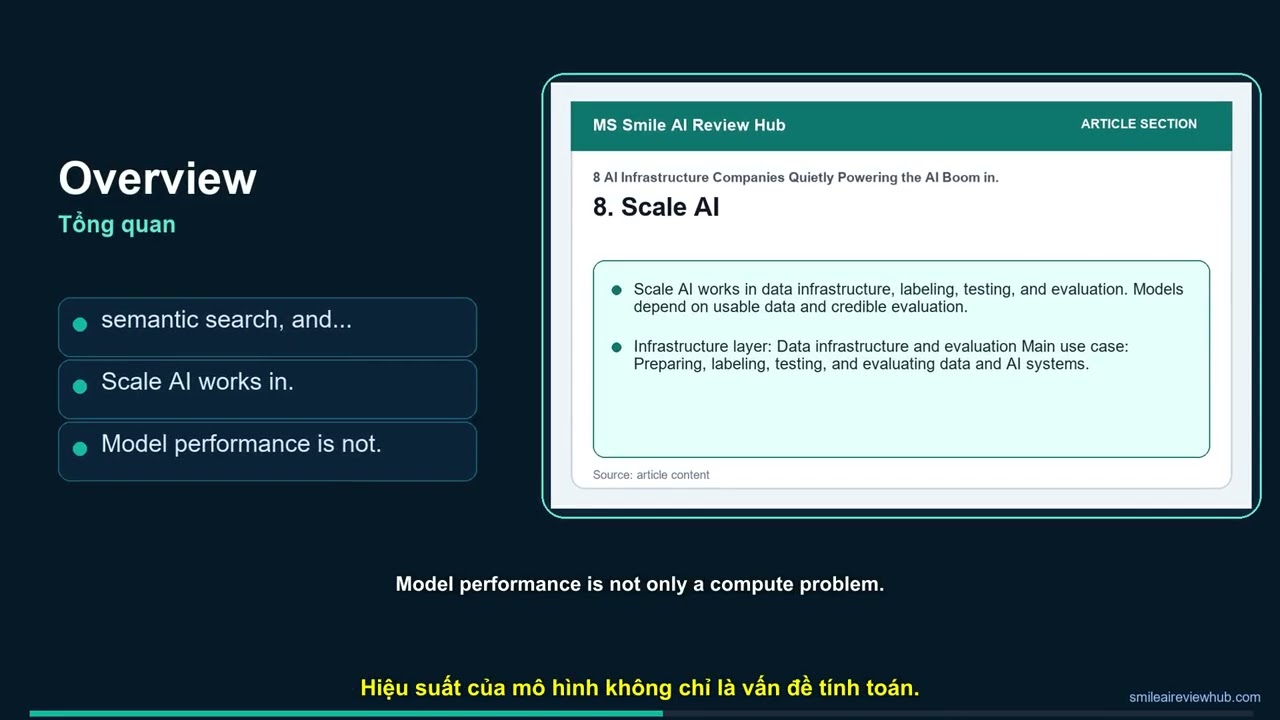
Scale AI works in data infrastructure, labeling, testing, and evaluation. Models depend on usable data and credible evaluation, so this layer can determine whether an AI system performs reliably in a real environment. The work may include preparing datasets, reviewing outputs, measuring performance, and supporting specialized deployment needs. Organizations should evaluate data governance, security, quality controls, domain expertise, and how evaluation connects to product decisions. Scale AI highlights a fundamental point: better compute cannot compensate for weak data processes, unclear evaluation criteria, or a system that has not been tested against realistic conditions.
Infrastructure layer: Data infrastructure and evaluation
Main use case: Preparing, labeling, testing, and evaluating data and AI systems
Best for: Organizations building data-intensive AI systems
Startups should avoid treating infrastructure as an afterthought. A prototype may work with small traffic while becoming financially or operationally difficult at scale. Developers need observability, reproducible environments, and clear failure handling. Creators and software buyers benefit from understanding whether an AI product depends on fragile workflows or has a credible operating foundation.
Investors can use the stack as a research framework rather than a list of recommendations. Different layers have different economics. Compute can require large capital investment. Developer platforms may face rapid competition. Databases and observability tools depend on sustained usage. Data and evaluation businesses must maintain quality and trust. Every company should be assessed on its own evidence and risks.
Metrics are based on public content activity and are updated monthly. They are not website visitor claims.
An AI infrastructure company supplies compute, chips, data systems, model platforms, databases, observability, deployment, or other technical layers used to build and operate AI applications.
No. GPUs are important, but AI infrastructure also includes chips, storage, networking, data preparation, model hosting, evaluation, monitoring, vector databases, security, and developer workflows.
Infrastructure choices affect cost, latency, reliability, security, development speed, and the ability to scale a product.
Understanding the underlying stack helps buyers evaluate product claims, data handling, operational risks, and long-term reliability.
No. This article is educational and does not provide investment advice. Infrastructure companies face competition, technology shifts, capital requirements, and execution risks.
The AI boom is powered by a connected stack, not a single model company or chip provider. CoreWeave and Lambda illustrate specialized compute. Cerebras represents alternative AI systems. Together AI supports model workflows. Weights & Biases helps teams understand experiments. Modal simplifies execution infrastructure. Pinecone supports retrieval. Scale AI highlights the importance of data and evaluation.
The practical lesson is to look beneath the visible application. Understanding infrastructure helps builders choose better systems, helps buyers ask better questions, and helps observers analyze the AI market with more precision. These eight companies are useful examples because they show how many specialized layers must work together before an AI product reaches the user.